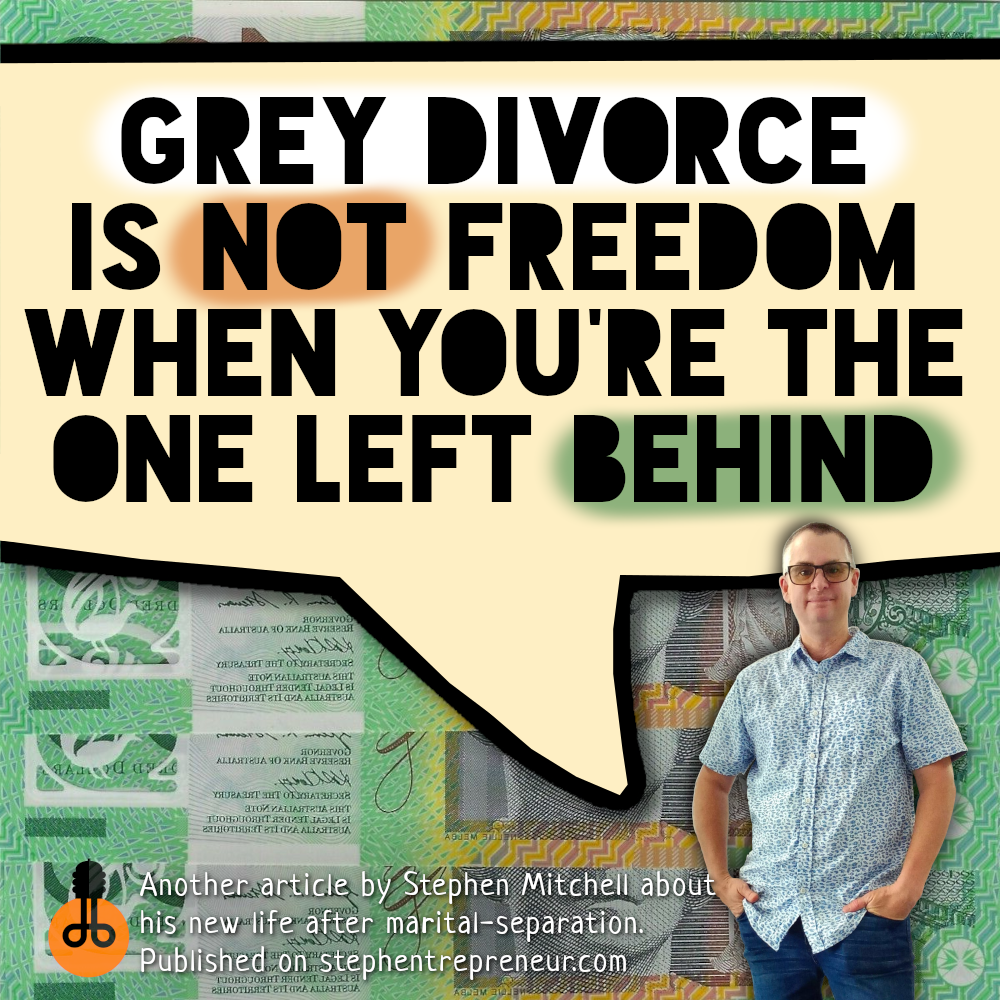
Choosing separation is EASY; Living with the aftermath is Not
Before anyone nods along too easily with the popular narrative around grey separation, it’s worth slowing the tape. This article by Spicy Auntie paints later-life divorce as a kind of moral awakening for women who are “finally choosing themselves“.
From where I stand, it often looks far less noble and far more brutal.
Walking away from a long-term marriage simply because you’re unhappy doesn’t land softly on the man left behind – it can break his spirit right down to the studs.
Women may choose divorce. Men, far too often, choose the ultimate life-changing event instead – and that’s worse, particularly when mental health is already stretched thin. Because good men, traditional men, don’t enter marriage casually. We marry for the long haul. Through broken bones and heartache, bad financial decisions and the occasional scratch-card win. Through unevenly divided or unspoken household chores, nappies, sleepless nights, and the long naps taken just to keep stress, anxiety, and depression at bay.
That context matters. Without it, we’re not telling the full story. We’re just applauding the exit and ignoring the wreckage left behind.

Grey divorce, apparently, is the fashionable term.
Makes it sound like a lifestyle choice, doesn’t it? Like switching to linen shirts or taking up sourdough. What it really meant was this: she left believing happiness could be rebuilt, rediscovered, or rebranded somewhere else. The marriage itself was seen as the faulty appliance, not the wiring that needed fixing on both sides.
Now, before anyone sharpens their pitchforks, I get it.
Staying and working things through is hard. Leaving feels decisive, hopeful, brave even. There’s a neat little story there – walk away, reset, glow up, live your best life. Much tidier than sitting in discomfort, therapy rooms, and awkward conversations that don’t resolve neatly by Tuesday.
From where I was standing, though, it felt less like a fresh start and more like someone pulling the pin and stepping back.
Suddenly, years of shared responsibility became “my truth” and “your truth”, with no shared middle ground left to stand on. Convenient, that.
Then came the money bit.
Oh yes, the romance really kicks in here. One house becomes none. One retirement plan becomes two slightly panicked guesses. Super gets sliced, savings evaporate, and we both stare down the barrel of a future with far less margin for error. The numbers don’t care who left or why. They just quietly punish everyone involved.
Housing after 50? That’s a treat.
Rentals that feel temporary and overpriced, or mortgages that lenders look at sideways. Independence is great until the washing machine dies and you realise there’s no backup plan.
And yet – here’s the bit that surprises even me – I’m cautiously optimistic.
Not delusional, mind you. I’m not expecting sunsets and violins. But there’s a steady, realistic hope in knowing I can build something smaller, simpler, and more honest. Not perfect. Just mine. Maybe there’s another life-partner in my future – but I am not focusing on that, not yet, maybe not at all.
So no, the future won’t be rosy. It’ll be practical.
A bit lonely at times. Occasionally unfair. But it’ll be real. And after all the slogans and silver linings wear off, that might be the most solid thing either of us ends up with.
(By “the slogans and silver linings”, I mean the tidy, feel-good language that often surrounds divorce – phrases about ‘fresh starts’, ‘choosing yourself’, or ‘new chapters’. Those ideas can help people leave, but they rarely carry anyone through what comes next. Over time, the optimism fades, the positives dull, and the practical realities step forward. What’s left then isn’t a narrative or a mindset, but the solid, ordinary life a person has to live with.)
The Quiet Consequence Neither Partner Likes To Name
Here’s the part that rarely makes it into the think-pieces:
Many men who go through grey divorce don’t swear off marriage out of bitterness.
They quietly opt out because they’ve already paid the full emotional price once. Who, in their right mind, wants to experience that level of loss twice?
These are often men who did everything right according to the rules of their gender. They provided, stayed, absorbed pressure, and believed endurance was part of love. And somehow, they’re still the ones punished for it.
The problem isn’t divorce itself. Sometimes separation is necessary, even unavoidable. The problem is how older women increasingly choose separation over reparation – choosing departure over the difficult, un-glamorous work of repair.
That choice doesn’t just end a marriage. It reshapes a man’s willingness to ever risk that level of commitment again.
And that consequence doesn’t show up in the statistics. It just shows up in quieter lives.

Discover more from The Entrepreneurial Life of Stephen Mitchell
Subscribe to get the latest posts sent to your email.
 The Entrepreneurial Life of Stephen Mitchell
Have a differing view or opinion, or agree wholeheartedly? Your response is welcomed!