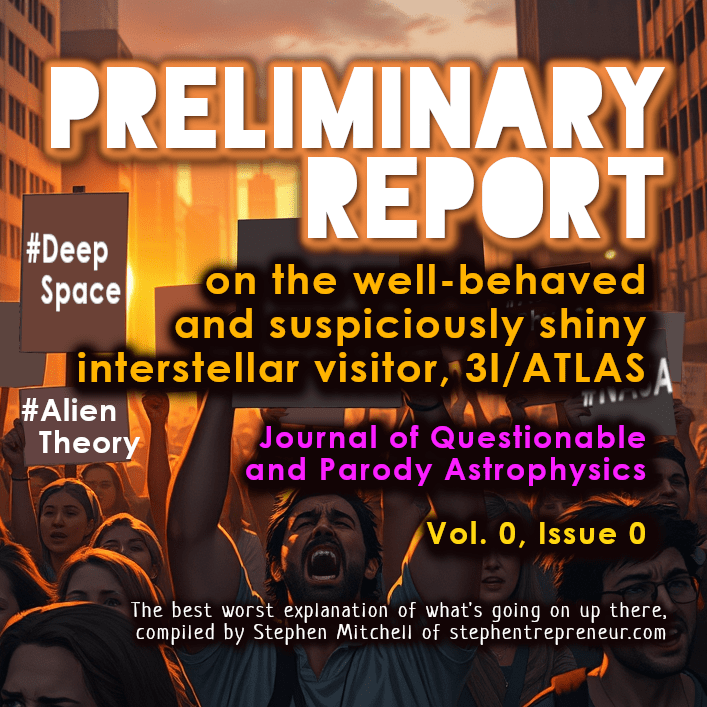
OK, our editors might have that slightly wrong. Maybe they meant to say the unusually shiny, suspiciously well-behaved interstellar object currently spreading its seed around our galaxy. Yet we will let it slide.

Abstract
Recent observations of the interstellar object 3I/ATLAS have produced findings so inconsistent with established astrophysical theory that the research team briefly considered switching fields.
Spectral analysis suggests a composition of near-pure nickel, a result traditionally categorised under “impossible” in most formation models. Additional anomalies – including unnatural reflectivity, nickel plasma emissions, and structured magnetic pulsing – further complicate attempts to file this object under anything resembling ‘normal’.
We present these findings here, with the caveat that we honestly have no idea what we’re looking at.
1. Introduction
Interstellar objects are typically icy, dusty, or otherwise unremarkable travellers that zip through our solar system ignoring local laws and speed limits. 3I/ATLAS, however, has displayed behaviour less in line with comets and more in line with fabricated drama. Initial assumptions of a standard dirty snowball were discarded once the object’s light curve indicated it behaves more like a loose chunk of industrial metal than anything nature should feasibly produce.
2. Methods
Spectral data were collected using telescopes equipped with instruments specifically designed to ruin a researcher’s week when anomalies occur. Reflectivity was measured by pointing expensive optics at the object and collectively gasping. Magnetic pulses were recorded by magnetometers which, according to the lab notes, “should not be doing that”.
3. Results
3I/ATLAS appears to be composed of ~100% nickel (± the usual disbelief), totalling an estimated 33 billion tonnes. Iron – typically nickel’s inseparable partner in cosmic metallurgy – is conspicuously absent, presumably off doing something more sensible elsewhere. Surface reflectivity is uniform, metallic, and notably unbecoming of anything formed by natural processes; several observers described it as “polished” and one as “freshly buffed”.
In addition, spectrometry detected jets of nickel plasma, because of course it did. These emissions produce an eerie, self-generated glow that researchers unanimously labelled “not helpful”.
Magnetic pulses emanating from the object are structured, rhythmic, and consistent enough to trigger immediate speculation, conspiracy theories, and an emergency meeting with the communications team.
4. Discussion
Possible explanations include:
a) previously unknown formation processes,
b) previously unknown cosmic metallurgy,
c) previously unknown laws of physics, or
d) something that was made on purpose by someone who is not returning our calls.
Although the research team refuses to invoke extraterrestrial engineering directly, they also refuse to not invoke it, placing the phenomenon in the prestigious scientific category of “we’re not saying it’s aliens, but…”
5. Conclusion
Whatever its origin, 3I/ATLAS presents a direct challenge to current astrophysical understanding and, inconveniently, to several senior researchers’ reputations. As it continues its passage through the inner solar system, it serves as a reflective, nickel-plated reminder that the universe remains deeply committed to confusing us.
There you go. Parody is as rich on the internet as there is nickel is in that comet.

Discover more from The Entrepreneurial Life of Stephen Mitchell
Subscribe to get the latest posts sent to your email.
 The Entrepreneurial Life of Stephen Mitchell
Have a differing view or opinion, or agree wholeheartedly? Your response is welcomed!