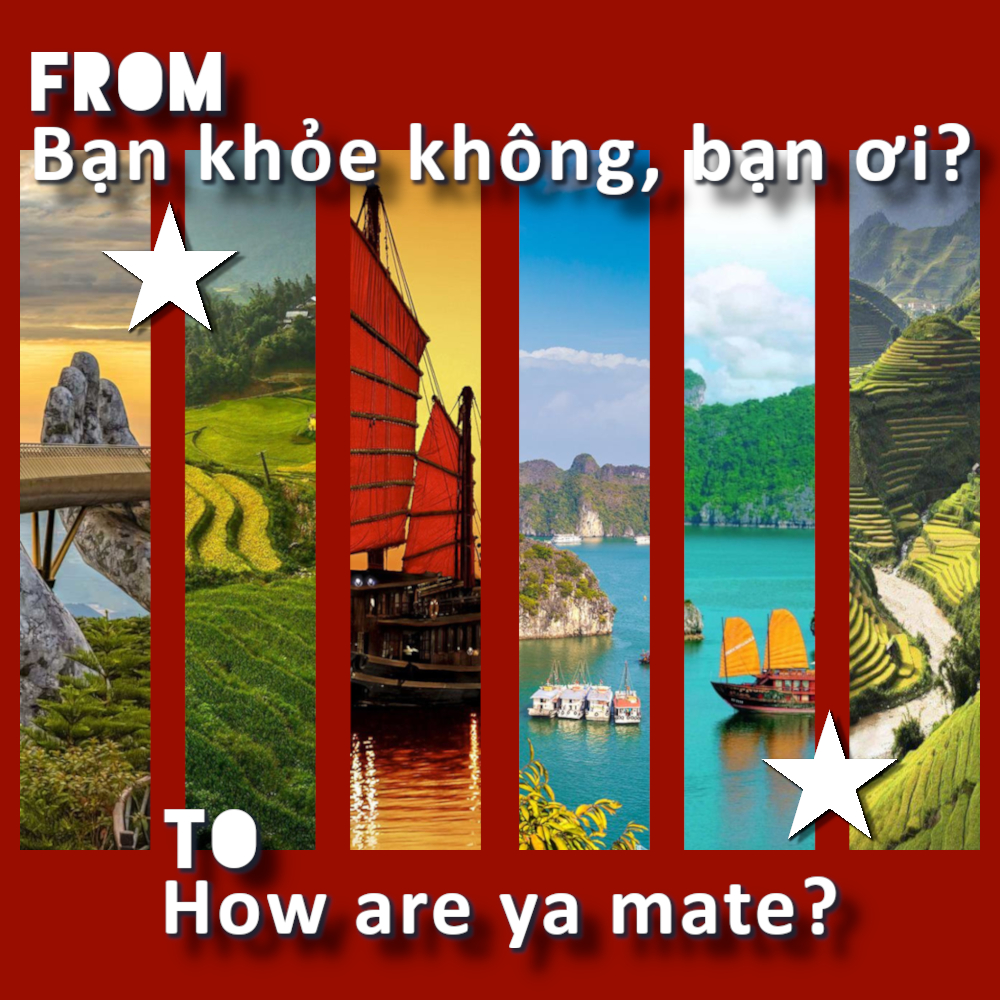
I recently offered to help a new Vietnamese friend with her English. Simple enough, right?
As soon as the words left my mouth, I realised I might’ve stepped into something bigger than I expected. This is going to be a journey filled with confusion, cultural curve-balls, and the occasional case of mutual head-scratching.
While I’ve always figured the Australian version of English is a pretty straightforward language, I’m now starting to see that it might not be quite as cruisy from the outside looking in.

English, in contrast, is a loose cannon – full of exceptions and constantly changing depending on tone, region, context, and, quite often, who’s passionately ranting about the subject based on their own experiences.
As I have discovered, other languages structure their sentences in wildly different ways:
- French and Spanish assign gender to just about everything — chairs, windows, feelings.
- Japanese and Korean alter speech based on politeness and social rank — sentence endings change depending on who you are and who you’re talking to.
- Arabic builds words off triliteral roots — change one letter, change the whole story.
- Mandarin turns one syllable into four different meanings depending on pitch.
- Vietnamese, in particular, is tonal, concise, and highly context-driven — which means much of what is understood isn’t actually said aloud.
Now stack that against Australian-English, where:
- Bark can be something a dog does or what’s on a tree.
- Spring might be a season, a jump, or a metal coil.
- We drive on a parkway and park on a driveway.
- Lead (the verb) isn’t the same as lead (the metal).
- And then there’s “Love” — which, much like the feeling itself, refuses to stay in one grammatical box:
- As a noun: “Love is patient, love is kind, love can wait.”
- As a verb: “I love the way you laugh at my terrible jokes.”
- As an adjective: “They met during a love story that wrote itself.”
- And while not technically an adverb, it still slips in creatively: “He looked at her love-like, without saying a word.”
Aussie slang is a unique beast in its own right:
- “She’ll be right.”
- “Strewth, what a ripper!”
- “Flat out like a lizard drinking.”
Try translating any of those without sounding like you’ve had a head knock!
So, what’s the real take-home message?
Helping a new mate to chat and ‘get a grip‘ on Aussie English shows that what feels natural might be a bit different for someone from a whole other linguistic and cultural scene.
There are major differences in the way language flows, sounds, and how folks interact. These elements will probably throw a ‘spanner in the works‘ when it comes to learning.
I suspect that if we ever do sit down together — perhaps with a pot of jasmine tea and a linguistic hammer — there will be a lot of laughing, a little confusion, and probably some beautiful moments of shared discovery.
It won’t just be about teaching her English. It’ll be about me learning how to teach, how to listen, and how to see my own language with fresh eyes. Whilst enjoying her sparkling eyes and beautiful smile.
Yeah… Nah…
For now, I’ll settle for pointing at things, saying the words slowly, and hoping we can one day dive into the finer points of Australian vernacular over a barbecue.
I look forward to her pretending to chuck another shrimp on the barbie and hit saying “How are ya, mate?” in a broken-english-slightly-aussie-vietnamese-accent ! That will be the day I know I will propose … that She is fully ‘strine mate!


Discover more from The Entrepreneurial Life of Stephen Mitchell
Subscribe to get the latest posts sent to your email.
 The Entrepreneurial Life of Stephen Mitchell
And THIS is my dilemma in Vietnam. “I feel crook as a dog” brings the most amazingly puzzled looks of bewilderment out in Vietnamese people.
LikeLiked by 1 person
Crumbs, the google translator changed that to:
“Tôi cảm thấy mình gian xảo như một con chó”
then converted that back to:
I feel cunning as a dog.
Not much of a cunning linguist!
LikeLiked by 1 person
I asked a pre-teen Vietnamese girl working in her parents’ hole-in-the-wall shop for six eggs. Google Translate turned that into ‘Can I have sex, please’. I didn’t read the translation before showing it to her, earning me a look that would destroy Kings and a slap in the face from her mother.
LikeLike